
Artificial intelligence is making it dramatically easier for businesses to do more.
We can analyze data, generate ideas, write software, create content and automate work faster than ever.
According to Statistics Canada, 19.2% of Canadian businesses reported using AI to produce goods or deliver services in the 12 months preceding its second-quarter 2026 survey, up from 6.1% two years earlier. Among businesses using AI, data analytics was the most commonly reported application.
For Edmonton businesses, this is not a distant shift. The Edmonton Chamber of Commerce has partnered with Grow with Google to expand practical AI education for local businesses, while Alberta continues investing in the province's artificial intelligence ecosystem.
The opportunity around AI is significant. But it creates another problem:
When technology dramatically increases the number of things an organization can do, how do leaders decide which things are actually worth doing?

The bottleneck is moving
Data analysis is a good example.
Not long ago, much of our analytical work involved writing Python scripts to clean, normalize, isolate and compare information. A significant amount of effort happened before we could get to the questions that ultimately mattered:
What does this data mean? Why is this happening? What should we do about it?
Today, AI can work with surprisingly raw information and help surface patterns, correlations and potential insights within minutes.
The work has not disappeared. The bottleneck has moved.
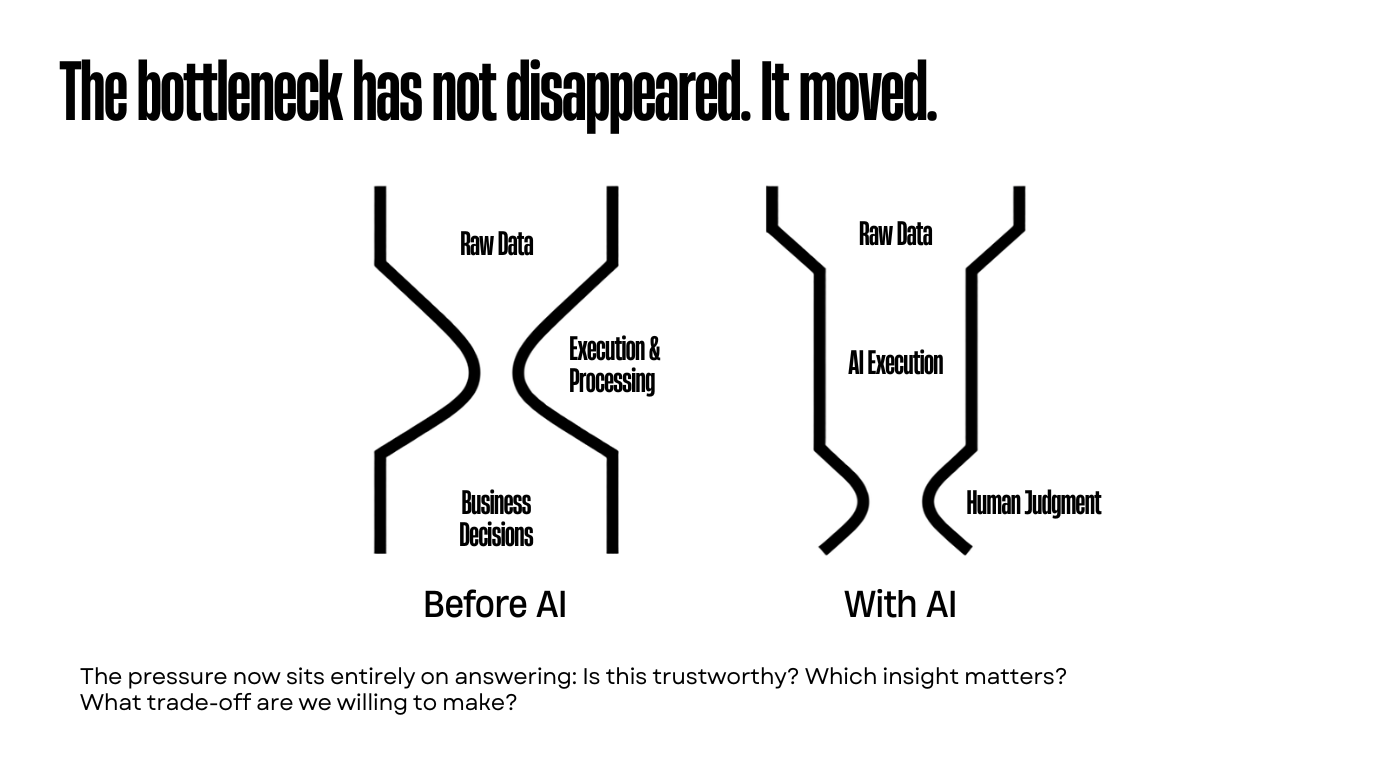
Instead of spending as much time producing the analysis, people can spend more time interpreting it.
That is valuable, but it also places more pressure on human judgment.
Is the analysis trustworthy? Which insight matters? What should we prioritize? Which opportunity actually fits our business? What trade-off are we willing to make? What happens next?
AI can get us to those questions faster. It cannot remove our responsibility for answering them.
AI changes where human value lives
Research is beginning to demonstrate this distinction.
An NBER study involving more than 5,000 customer-support agents found that access to a generative AI assistant increased productivity by approximately 14% on average, with particularly large gains among less-experienced workers.
But capability does not automatically translate into better judgment.
In separate research involving 758 Boston Consulting Group knowledge workers, participants using AI performed considerably better on tasks that fell within AI's capabilities. But when researchers introduced a complex task outside that frontier, people using AI were less likely to arrive at the correct answer. Harvard Business School described this as the "jagged technological frontier" of AI.
That distinction matters.
AI can make people faster without making every decision better.
As execution becomes easier, context, critical thinking and judgment become more valuable.
This is where brand becomes a business tool
Brand is often reduced to identity, marketing or communication.
For leaders, it should mean something much larger.
A strong brand creates organizational clarity around who you serve, the value you create, what you want to be known for, how you compete and what you are unwilling to compromise.
That clarity becomes a compass.
If AI identifies five markets you could pursue, your brand helps determine which one fits.
If it generates fifty campaign ideas, your brand helps determine which reinforce the position you want to own.
If technology allows you to automate part of your customer experience, your brand helps determine where efficiency improves the experience and where human interaction remains part of the value you provide.
AI can increasingly help answer "What could we do?"
Brand helps leaders answer "What should we do?"
From AI adoption to AI advantage
The danger is not that AI cannot generate enough ideas.
It is that organizations can now execute bad ideas faster than ever.
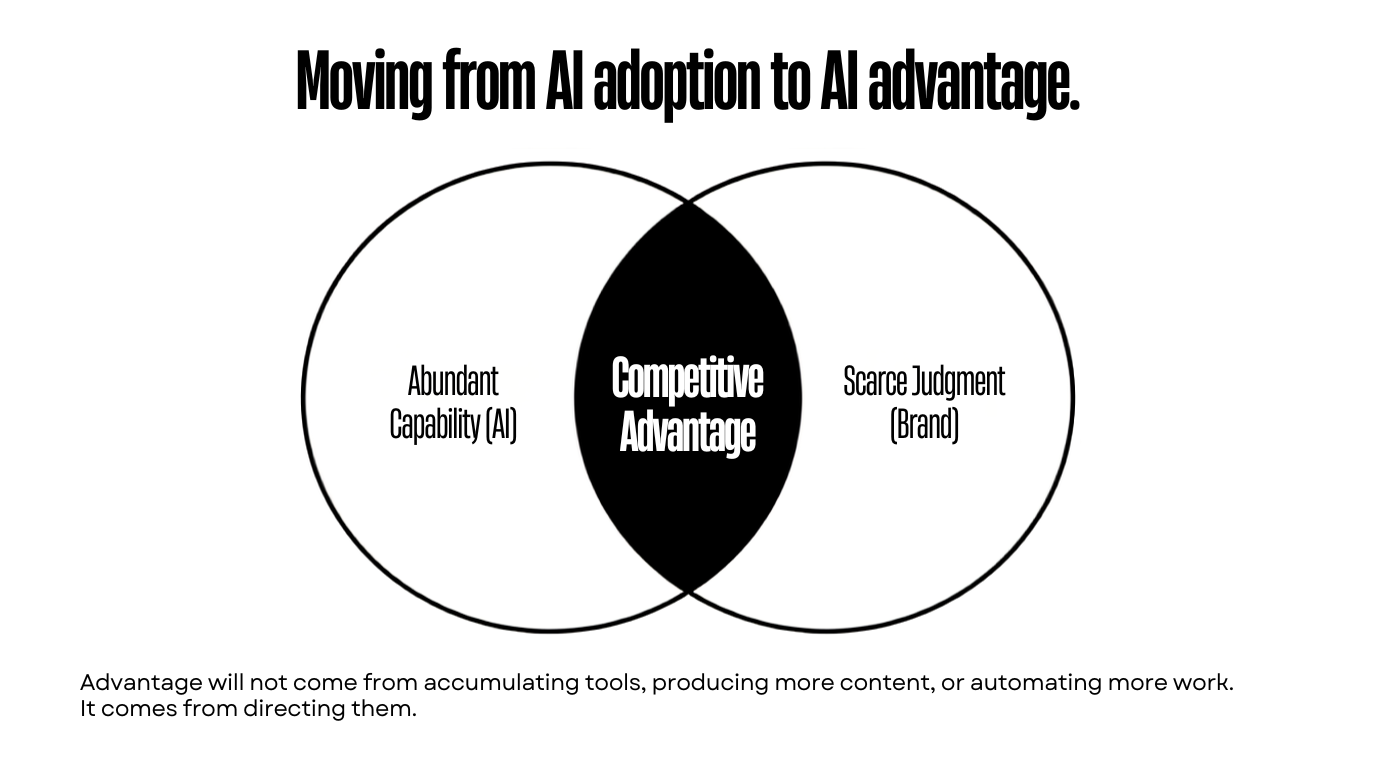
Competitive advantage will not come simply from accumulating AI tools, producing more content or automating more work.
It will come from combining new capability with better judgment.
For business leaders, that means becoming clearer about customers, priorities, positioning and the type of organization they are trying to build.
AI is making intelligence and execution more abundant.
Judgment remains scarce.
Brand gives that judgment direction.
So the question for Edmonton's business leaders may not simply be:
"How can we use more AI?"
It may be:
As AI makes more things possible for your business, are you becoming equally clear about which things are worth doing?
Author: Tom Jackson is the Founder of JAXONLABS, an Edmonton-based brand strategy and innovation firm. Through brand strategy consulting and executive coaching, JAXONLABS helps leaders create organizational clarity, strengthen decision-making and turn strategy into meaningful action.
Member Blog
Want to share your story? Are you an expert in your area? Submit your blog today!
Please note: submission does not guarantee your blog will be posted.