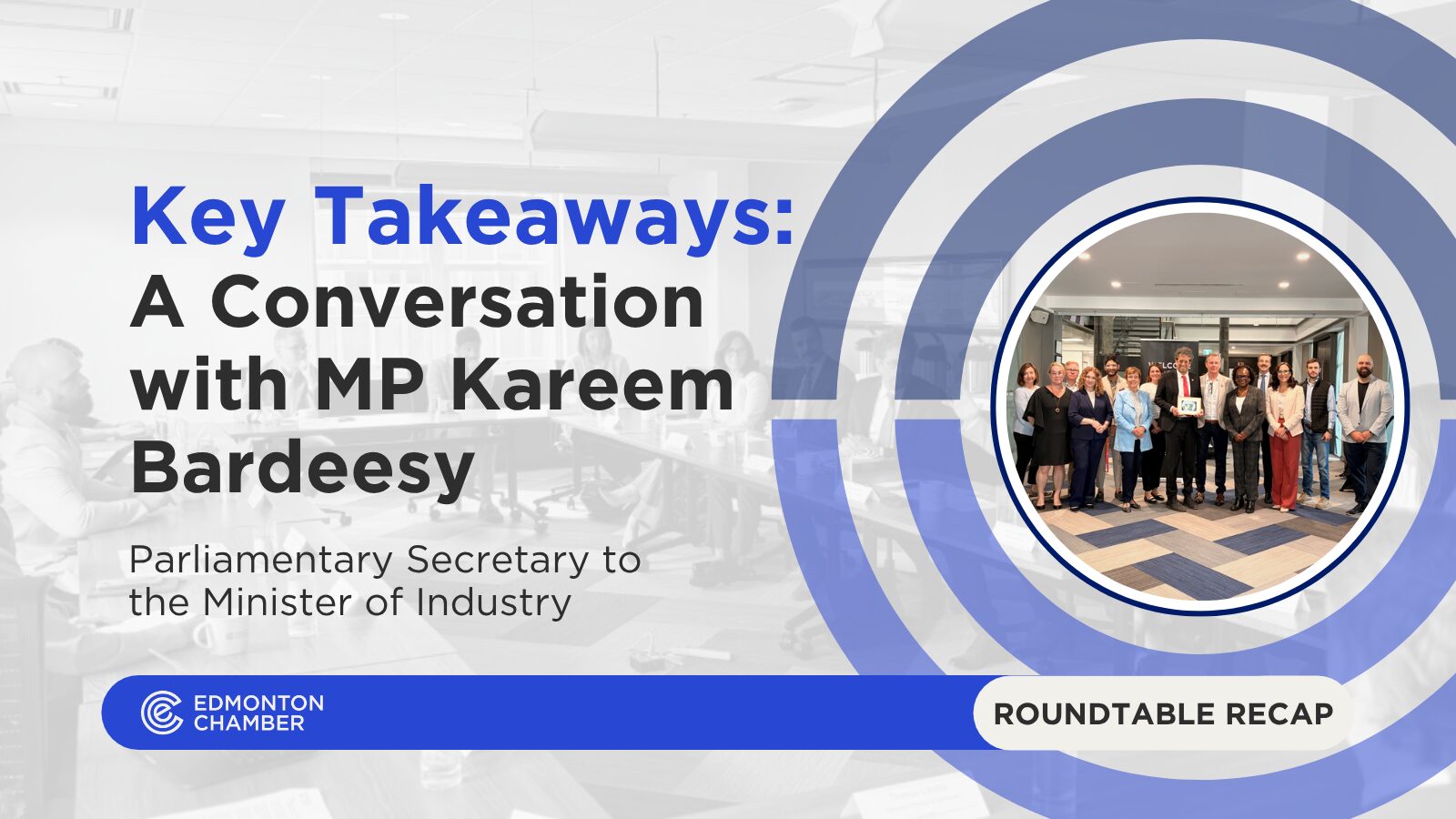
On July 21, 2026, the Edmonton Chamber of Commerce hosted MP Karim Bardeesy, Parliamentary Secretary to the Minister of Industry, for a roundtable with business, post-secondary, and community leaders from across Edmonton's aerospace and defence, industrial development, post-secondary, and downtown revitalization sectors.
PS Bardeesy was in the city for the Pacific Northwest Economic Region Summit and used the visit to hear directly from the region about where federal support is needed most. The conversation centred on Edmonton's growing role in Canada's defence and aerospace industry, the region's approach to industrial investment and red tape reduction, and what's needed to grow the North.
A defence sector ready to scale, waiting on Ottawa
Business and post-secondary leaders pointed to Edmonton's momentum as a defence and aerospace hub, from a dual-use research ecosystem already backed by tens of millions in provincial funding, to a planned Air Force base with hundreds of millions in facility work already committed. What's missing, participants said, is a final federal investment decision — the step needed to unlock training programs, private investment, and a broader aviation and defence training campus.
Core infrastructure needs to keep pace with growth
The group raised the deteriorating state of the highway connecting Edmonton to Cold Lake, calling for it to be treated as core infrastructure rather than an afterthought as military, energy, and commercial traffic on the route continues to grow. More broadly, participants noted that transportation and connectivity investments need to scale with the region's population growth if Edmonton is to keep attracting major projects.
Turning red tape reduction into a national model
On investment attraction, business leaders held up Alberta's Industrial Heartland — hundreds of square kilometres of pre-zoned, pre-assessed industrial land — as proof that pre-coordinated regulatory approval speeds up major projects, pointing to billions of dollars in recent net-zero and data centre investment as evidence. Rather than a patchwork of case-by-case approvals, participants called for the federal government to apply that same pre-coordination model more broadly, along with permanent tax measures like the Accelerated Capital Cost Allowance to keep large capital projects competitive.
Edmonton wants to be Canada's front door to the North
Participants made the case for a stronger federal presence in northern development, pointing to Edmonton's role as the logistics, training, and flight-connectivity hub for communities across the North. Workforce training, not funding announcements alone, was identified as the real determinant of whether the region can meet the demand coming from northern and defence-related growth.
Certainty matters as much as funding
On apprenticeship, immigration, and workforce policy, the group emphasized that predictable, well-coordinated federal-provincial commitments matter more than the size of any single announcement, since building a new training pathway can take years. Participants also raised the reputational drag that international student issues in other provinces have placed on Alberta's institutions, and called for a broader toolkit for downtown investment that goes beyond tourism funding to include safety, security, and housing supports.
What's Next
The Edmonton Chamber of Commerce will continue to build its relationship with the federal government to ensure the voice of Edmonton business is reflected in national defence, industrial, and northern development strategies.
PS Bardeesy closed the session by committing to bring the region's priorities back to the Minister of Industry and federal colleagues, and to continue working with the Chamber on the asks that came out of the discussion.
Have your say.
The Edmonton Chamber wants to hear from you. What are the top issues and priorities for your business? Start the conversation by writing to policy@edmontonchamber.com.