
September 15, 2026
Economic Learning Mission to Ireland: State of the Economy
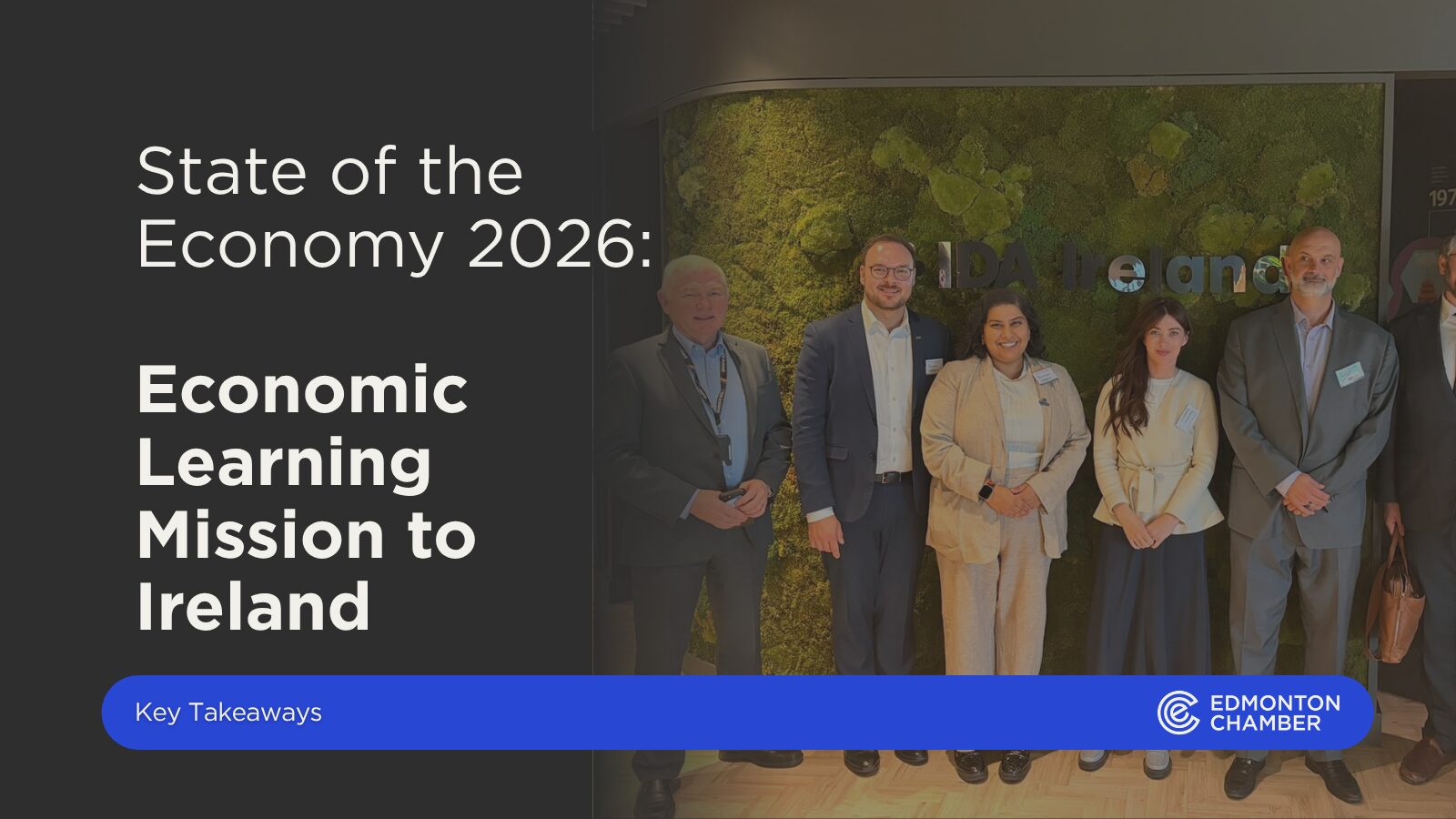
Last year, the Edmonton Chamber of Commerce launched Edmonton's first comprehensive economic scorecard, benchmarking our region against other major Canadian economies in our inaugural State of the Economy report. The 2026 edition examines the 10 industry clusters driving the Edmonton region, from the established anchors carrying today's GDP and employment base to the emerging sectors positioned to drive tomorrow's growth.
That research raised an obvious question: if Edmonton wants to convert its areas of specialization into durable competitive advantage, who has done it well? Ireland kept surfacing as the answer.
The comparison isn't perfect, but the structural parallels are real: a small population competing in large global markets, strong post-secondary and research capacity, and an economy built on international trade and investment. Over several decades, Ireland turned those conditions into globally significant clusters in pharmaceuticals, medtech, technology, and financial services, along with the foreign investment that follows scale and specialization.
So as part of our 2026 research, we went to see the mechanics firsthand and asked directly: how did you do it, and how much of it is transferable to Edmonton?
Heather Thomson (VP, Economy and Engagement) and Akanksha Bhatnagar (Executive Director, External Relations) led a three-day mission to Dublin and Galway, joined by Adrian Warchola (Edmonton International Airport), Dr. David Bressler (University of Alberta), and Andrew MacIsaac (Applied Pharmaceutical Innovation).
Meetings spanned the institutions that build competitiveness: Dublin Chamber, World Trade Centre Dublin, IDA Ireland, Irish Funds, the Irish Fiscal Advisory Council, Byrne Wallace LLP, Dublin Airport, Galway City Council, regional economic and innovation leaders, and Medtronic Galway. Topics ranged from investment attraction and fiscal policy to commercialization, infrastructure, talent, aviation, and advanced manufacturing.
The throughline: competitive economies are engineered, not accidental. Ireland spent decades building the conditions around its chosen strengths: talent, research capacity, infrastructure, capital, international connectivity, and institutions that plan past a single election cycle. Its growing pains, including housing and infrastructure strain from rapid growth, are equally instructive.
On November 18, we'll present the findings: what Edmonton can practically apply, and concrete recommendations for converting our strengths into investment, productivity, jobs, and long-term growth. Toni Gravelle, Deputy Governor of the Bank of Canada, joins to place Edmonton's trajectory within the national economic outlook.
Last year we asked how Edmonton is doing. This year: what could Edmonton become?
Click here to explore membership and help shape the future of business in Edmonton.